

Sotiris N Nikolopoulos, Fotini Pouliou and Michael Papaharalambous

Fish eggs are known for their antioxidant and antiaging properties, making them beneficial natural supplements with respect to aging. In the present study, we investigated in vivo the potential effects of a klotho regulator supplement, Klo-Cel. KLO-CEL in the expression of genes associated with aging and longevity. Blood samples drawn from 14 apparently healthy males and females from all ages taking KLO-CEL (treated group) or taking no supplementation (control group) were analyzed for changes in the expression of KLOTHO, COL1A1, COX2 and GABPB1 genes. Participants’ blood samples were collected before Klo-Cel intake, as well as after 30 or after 60 days on KLO-CEL intake. In addition, blood samples were collected for some participants after 30 and 60 days upon KLO-CEL intake discontinuation.
Treatment with KLO-CEL for 60days dramatically increased the expression of the anti-aging genes KLOTHO (up to 250-fold; p < 0.0001) and collagen-1 COL1A1 (up to 18000 fold; p=0.0001). In sharp contrast, at the same time point of 60 days treatment, COX2 expression remained constant for most of the participants or was significantly reduced in some participants blood samples. This dramatic effect on gene expression of KLOTHO and COL1A1 was evident even 30 days after KLO-CEL discontinuation albeit 10-15% reduced, but lost after 60 days KLO-CEL discontinuation. No significant changes in all analyzed genes expression was observed in the control group. In summary, Klo-Cel enhances dramatically the expression of the anti-aging genes KLOTHO and COL1A1, thus demonstrating a powerful effect of this particular sturgeon fish supplement in aging prevention.
Overall, 14 persons apparently healthy male and female participants from all ages were recruited and treated fortwo months with KLO-CEL. Accordingly, 5 individuals were evaluated in parallel without receiving any supplementation of KLO-CEL ( control group). Blood samples were collected along with clinical evaluation of overall functions at the beginning and at the end of the treatment period (day 0 and day 60). The measurements were also repeated two months after treatment discontinuation. Informed consent for participation in the study was obtained from all participants. Inclusion criteria were: age between 18 and 85 years, non-smoking status, normal blood pressure values, body mass index values below 30 kg/m2, no clinical cardiovascular diseases, no history of any other chronic diseases.
Expression of Longevity Genes
We monitored the expression of longevity genes KL and
COL1A1 in the KLO-CEL treated group, as well as in
control group (no KLO-CEL intake). Significant
differences in the expression of both KL and COL1A1
between the groups were only observed after 60 days of
treatment. Two months after treatment discontinuation,
the expression of longevity genes in all treatment groups
decreased to initial values (before KLO-CEL treatment).
In contrast in the control group, expression of both KL
and COL1A1 genes did not change during this time
period.
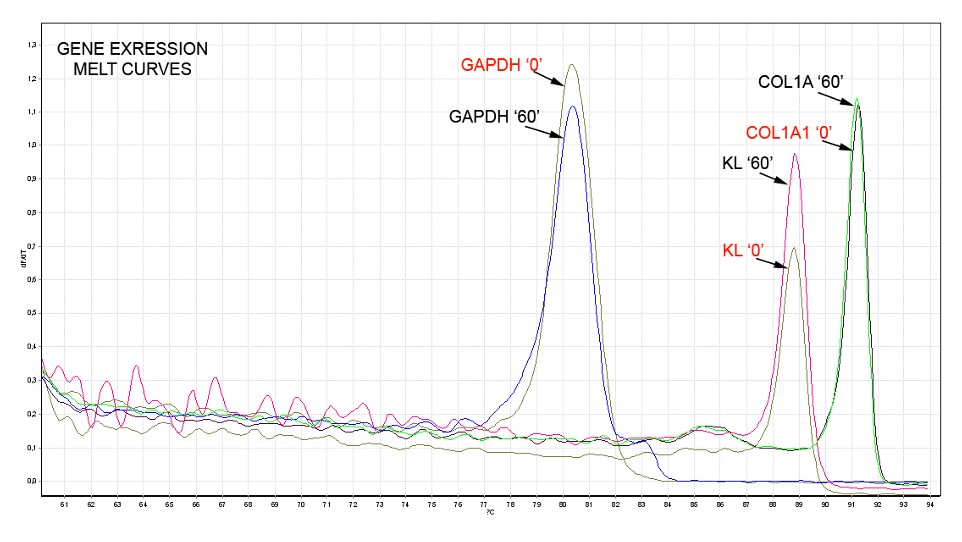
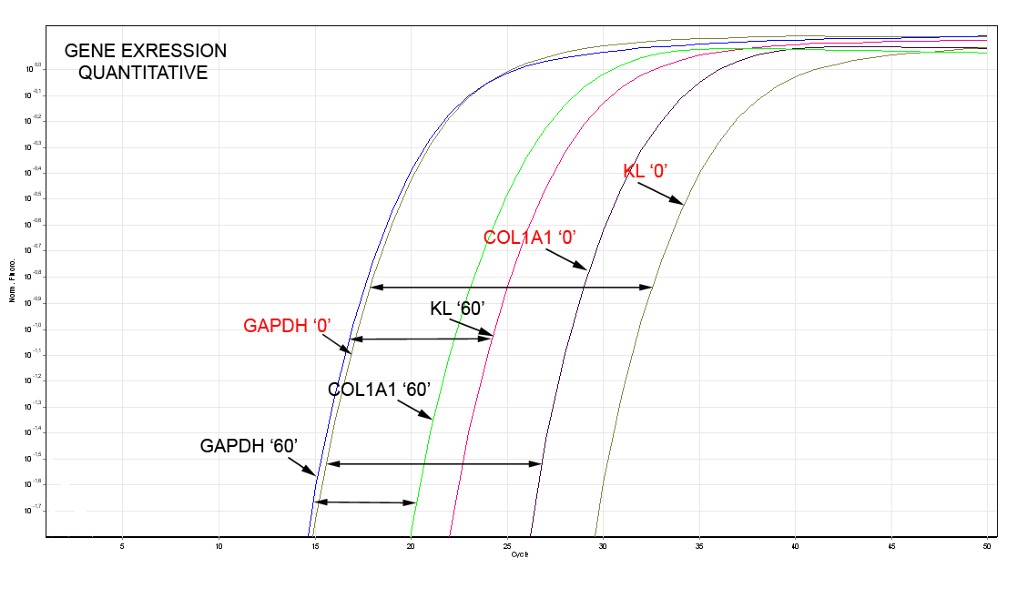
FIGURE 1: Real-time PCR data from blood samples collected from a study participant. With “0” it is denoted the expression of the corresponding genes (KL, COL1A1, and the reference gene GAPDH) before KLO-CEL intake (red characters). With “60” it is denoted the expression of these genes after 60 days on KLO-CEL (black characters). The DNA synthesis and quantitation curves that correspond to each gene’s expression are shown (TOP). The melt curves that correspond to the expected and correct product for each gene examined are shown (BOTTOM).
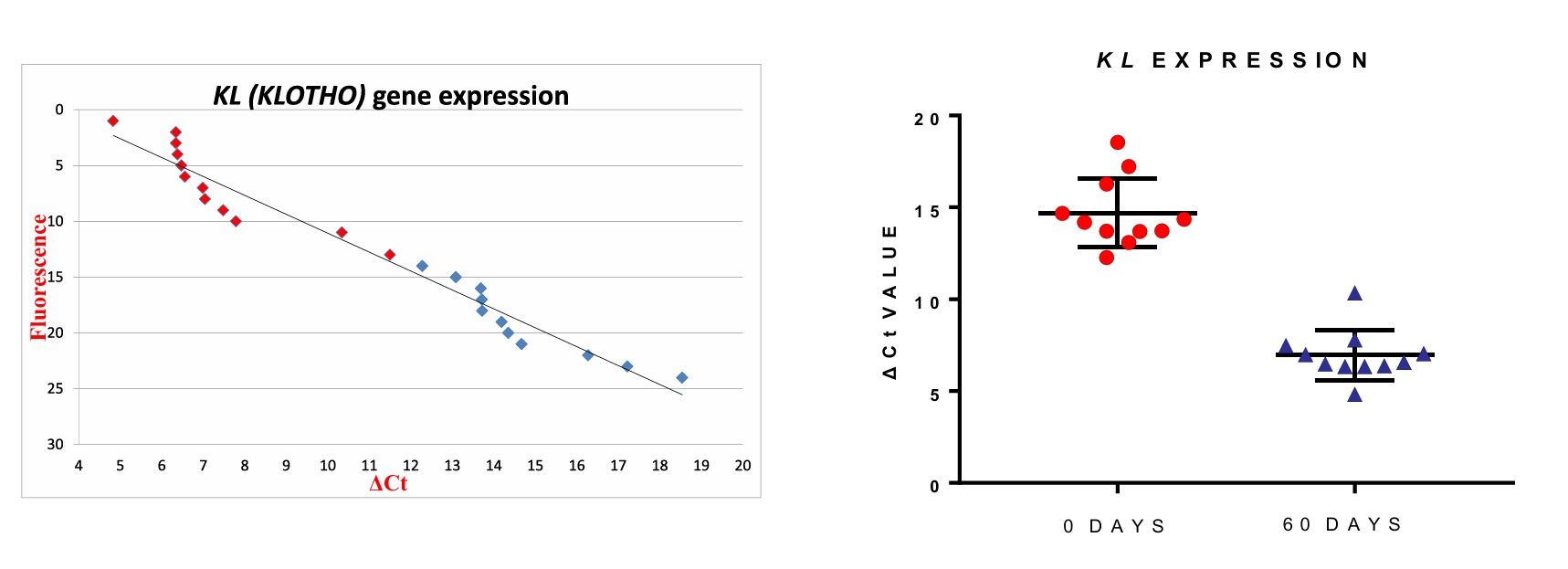
FIGURE 2: Graphical representation of KLOTHO (KL) gene expression distribution in different blood samples. Red diamonds represent the relative levels of gene expression of each participant blood sample drawn after 60 days on KLO-CEL (time 60 DAYS). Blue diamonds represent the relative levels of KLOTHO gene expression of each participant blood sample drawn the day before KLO-CEL intake (time 0 DAYS). ΔCt=(CtKL-CtGAPDH)
FIGURE 3: Graphical presentation of KLOTHO (KL) expression relative to housekeeping gene GAPDH (ΔCt (CtKL -CtGAPDH)), for participants receiving KLO-CEL. Dots represent KL expression values of participants before KLO-CEL intake (0 DAYS), while triangles represent KL expression values of the same participants after 60 days on KLO-CEL.
KLO-CEL intake increased the expression of the KLOTHO gene after 30 days of treatment up to 4-fold (p<0.001) in all participants, while after 60 days this increase was dramatic, up to 250-fold (p<0.0001) compared to 0 days treatment, as well as to KLOTHO gene expression of the control group, where no significant changes observed. Characteristic example of a case of 83 years-old male with no detectable expression of KLOTHO at 0 days, presented with high levels of KLOTHO after 60 days on KLO-CEL. In addition, 30 days after KLO-CEL intake discontinuation, the expression of KLOTHO gene was still at dramatically high levels, albeit 10-15% lower compared to the 60 days treatment levels. However, two months after KLO-CEL intake discontinuation, KLOTHO gene expression levels were back to the initial levels observed at 0 days time point.
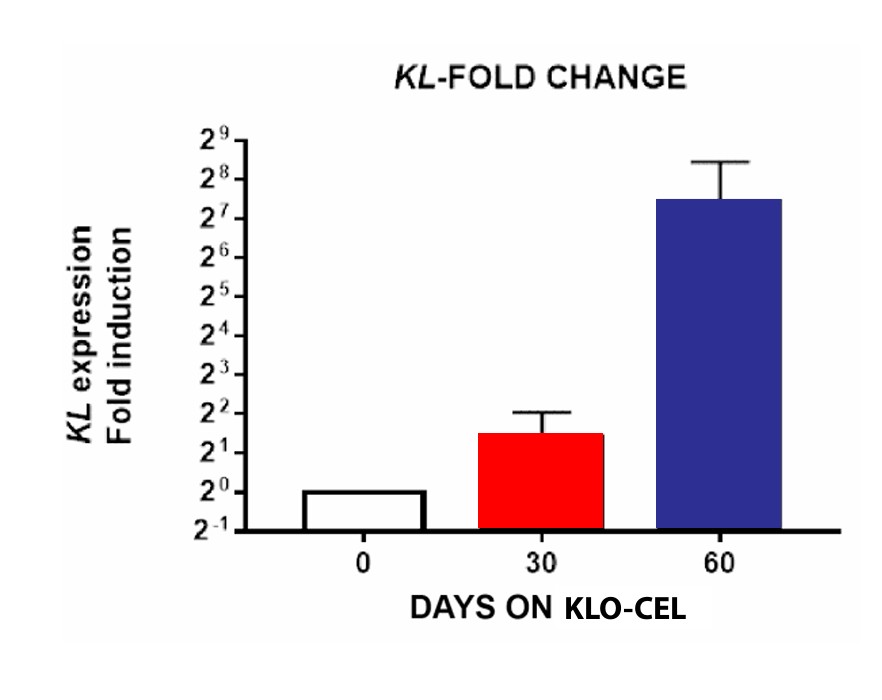
FIGURE: Graphical presentation of relative changes in the expression of longevity genes of all participants blood samples upon KLO-CEL intake: KLOTHO. "0" represents the time before KLO-CEL intake, "30" represents the time after 30 days on KLO-CEL intake and "60" represents the time after 60 days on KLO-CEL intake.
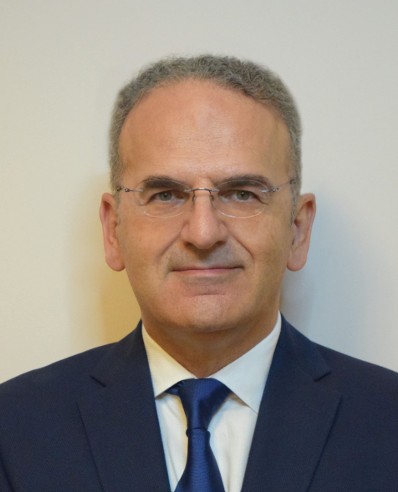
Dr. Sotiris has made significant contributions to the field of molecular and cellular biology, particularly in oncology. His research has been recognized and supported by prestigious fellowships from the NIH and the American Heart Association. He has held esteemed positions at leading institutions and has published numerous influential papers in high-impact journals. His work continues to advance our understanding of cancer biology and molecular mechanisms as the President and Scientific Director, Center for Molecular Analysis and Research SA, in Greece.
Disclaimer: Klo-Cel is a food supplement and is not intended to diagnose, treat, cure, or prevent any disease. It should not be used as a substitute for a varied, balanced diet and a healthy lifestyle.

KLOTHO: THE SECRET TO LONGEVITY, ANTI-AGING, AND TRANSFORMATIVE HEALTH.
© Copyright 2026 Celvante SA. All rights reserved
